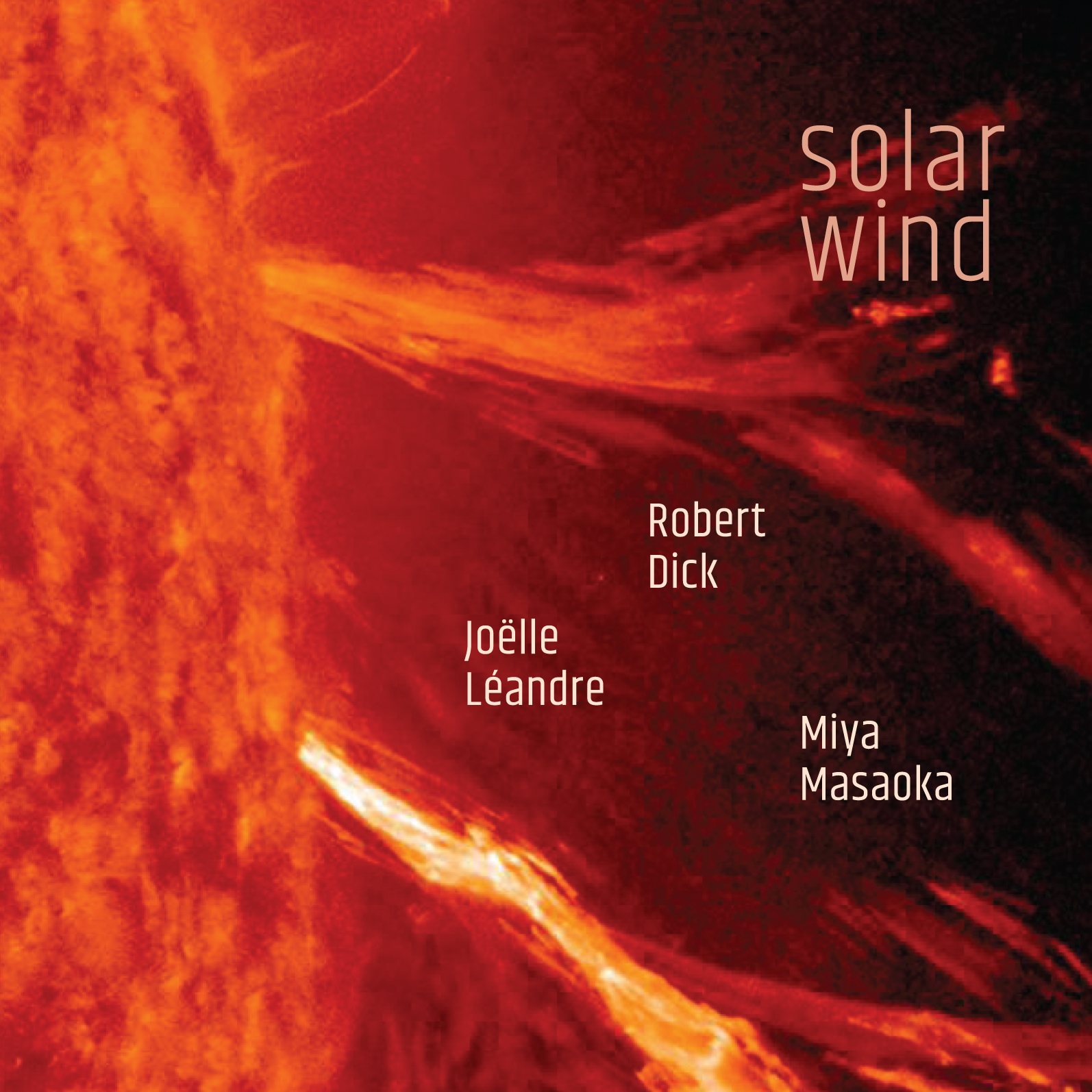
Solar Wind
No matter how far one musician pushes, the others meet them there, ensuring the trio always moves as a single, untethered body.
“Solar Wind” brings together three fiercely independent masters of contemporary improvisation — Robert Dick, Joëlle Léandre, and Miya Masaoka — for a trio encounter that feels less like a studio session and more like a convergence of natural forces. Conceived by Masaoka, who had long wanted to expand her duo work with Dick into a trio, the album was recorded at Mavericks Studio in New York on September 28, 2018, by engineer John Epperly. It stands as one of the most distinctive late-period releases in the Not Two catalog — a recording where three singular musical languages collide, intertwine, and ultimately form a unified, living organism.
Each musician arrives with a fully formed aesthetic. Dick, long celebrated for redefining the flute's expressive possibilities, moves among glissando flute, bass and contrabass flutes, piccolo, and voice, bending pitch and timbre with a microtonal flexibility that few wind players can match. Léandre, one of the central figures of European free improvisation, brings her unmistakable contrabass sound — deep, vocal, physical. Both she and Dick punctuate the record with voice on select pieces, folding wordless vocal fragments directly into the instrumental texture rather than treating them as separate gestures. Masaoka, on koto, electronics, and percussion, draws on both Japanese tradition and contemporary experimental practice, using plucked, bowed, and prepared techniques — along with real-time processing of her own playing — to create a sound world that is at once ancient and startlingly modern.
What makes “Solar Wind” so compelling is the way these three distinct vocabularies merge without losing their individuality. The trio listens with microscopic attention: a single breath from Dick can redirect the ensemble; a bowed overtone from Léandre can shift the emotional temperature; a koto resonance from Masaoka can open an entirely new harmonic horizon. Lines begin with one instrument and morph seamlessly into another, solos dissolve into duos and trios, and the music moves with the unpredictability of weather — sudden eruptions, quiet eddies, dense spirals, moments of suspended stillness. Twelve pieces make up the set, their titles as evocative as the playing itself — "Friends of the Sun," "How Old Is Your Shadow?," "Prepsychotic Philosophers" among them.
The album's range is striking. One piece may erupt with explosive intensity, another may hover in near-silence, built from fragile textures and barely articulated gestures. Microtonal bends, string pressure, breath noise, harmonics, and vocal fragments all become structural elements. The trio's shared commitment to sound exploration — to timbre as form, gesture as architecture — gives the music its coherence. No matter how far one musician pushes, the others meet them there, matching energy with energy, subtlety with subtlety, ensuring the trio always moves as a single, untethered body.
The stylistic breadth is enormous: echoes of 1960s avant-garde jazz, contemporary classical language, electroacoustic sensibility, noise-based textures, world-music inflections, and the unmistakable imprint of Japanese traditional music. Yet nothing feels grafted on. The trio finds an organic link between these worlds, creating a music that is fluid, unpredictable, and deeply alive.
In the context of Not Two's long history of documenting fearless improvisation, “Solar Wind” stands out as a recording of uncommon invention and vitality — a meeting of three artists who share not only virtuosity but a restless desire to explore. It is music that glows from within: intense, subtle, volatile, and at times transcendent. A late-catalog gem, and one of the most compelling trio statements the label has released.