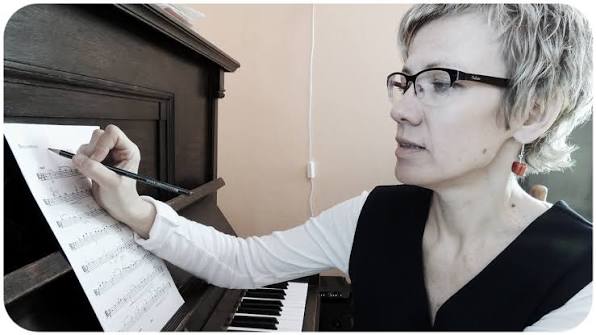
Interview with Magdalena Cynk
Today we talk to Magdalena Cynk — a composer whose work bridges regional history, folk traditions, and cosmic imagination. Rooted in Toruń yet open to the wider universe, she creates music shaped by literature, art, astronomy, and the living pulse of Polish culture. In this interview, she reflects on the inspirations that guide her work and the creative choices that define her voice.
Not Two Records: What are the main sources of your artistic inspiration?
Magdalena Cynk: My inspirations come from literature, art, my surroundings, and even the cosmos. As the text states, “She draws inspiration for her compositions from deliberate sources—literature, art, her surroundings, and even the cosmos.” But my creative vision is deeply rooted in Toruń and the Kuyavian-Pomeranian region, whose history and culture shape many of my works.
NTR: How does Toruń’s heritage appear in your compositions?
MC: A clear example is my Incorporation Cantata (2004), written for the 550th anniversary of Toruń’s homage to King Casimir Jagiellon. It incorporated the historic Tuba Dei bell — “incorporated the historic Tuba Dei bell from Toruń’s Cathedral of St. John.” Later, in 2017, I revisited these themes in my Second Toruń Peace Cantata, using excerpts from the Treaty of Toruń (1466).
NTR: Why is the rafters’ song Hej flisacza dziatwo so important in your music?
MC: It’s a melody central to Toruń’s identity. The document describes it as “a melody steeped in local legend… once broadcast as the opening signal of Toruń’s Polish Radio station.” I’ve used it in many works — Flisaczy String Quintet, Flisacza Sinfonietta, Flisacza Miniature, Flisacze Variations — each time transforming the motif in new ways.
NTR: How did astronomy become one of your creative inspirations?
MC: My first astronomical piece was Campane PSR 1257+12 (1997), inspired by Aleksander Wolszczan’s discovery of exoplanets. Between 2005 and 2023, I composed 20 “asteroid” works, “each dedicated to cities or luminaries of science and culture.” Many take the form of stylized dances — for example, Asteroid 2246 “Bowell” becomes a tango.
NTR: How do Polish folk traditions influence your compositional style?
MC: Folk elements permeate my work — modal scales, mazurka and oberek rhythms, and melodies inspired by highland, Jewish, and Romani traditions. As noted, “Folklore also permeated her work—whether through modal scales… or melodies inspired by highland, Jewish, and Romani traditions.” This is especially present in 7 Dances of Kujawy and Kashubia and Sinfonietta Bałtycka.
NTR: Which Polish composers have influenced you the most?
MC: Penderecki, Górecki, Kilar, and Lutosławski. Their sacred themes, minimalism, and authority shaped my artistic development. The text states, “Penderecki’s sacred themes, Górecki and Kilar’s minimalist textures, and Lutosławski’s compositional and personal authority had all left indelible marks.”
NTR: How has the carillon influenced your compositional thinking?
MC: The carillon’s resonance, overtones, and limitations profoundly shape how I think about sound — even in non-carillon works. As written, “the carillon's long resonance, rich harmonic overtones, and particular technical limitations shaped her musical thinking.” My Flisacza Miniature (2006) was the first original Polish composition for carillon.
NTR: What has your experience been as a woman in classical composition?
MC: Opportunities have expanded greatly — scholarships, competitions, festivals. Yet inequality persists in major orchestral repertoires. I once said women had to “work twice as hard to prove their worth.” Today, many of my most gifted composition students are women — intuitive, sensitive, and enterprising.
NTR: How do you decide whether to draw on tradition or explore new creative territories?
MC: It depends on artistic intent, emotion, and inspiration. Sometimes I consciously reference tradition — as in Love Sonnets. Other times I break conventions, like in Dance of Fire, which uses aleatoric techniques. The document notes, “her decision… depended on multiple factors: artistic intent, personal experiences, emotions, and moments of inspiration.”
NTR: What are your thoughts on the evolution of classical music in the 21st century?
MC: Today’s music is pluralistic and open. I see a return to melody and tonal clarity, and exciting interdisciplinary fusions. But I’m concerned about AI-generated music and virtual orchestras. As written, “she worried about the implications of AI-generated compositions and the potential replacement of live orchestras.” Still, I believe the human element in performance remains irreplaceable.
NTR: What is your personal opinion about jazz—especially free jazz—and has its improvisational spirit ever influenced your own compositional thinking?
MC: Jazz — and especially its creative freedom — is very close to me. Although I am not a jazz composer, in many of my pieces I consciously draw on elements characteristic of this musical language: jazz harmony, syncopated rhythms, and richer chordal color. I listen to jazz with great pleasure and value its extraordinary energy and authenticity. Many of my compositions were born out of improvisation at the piano. It is this spontaneous search for new sounds and musical relationships that often becomes the beginning of the creative process. Improvisation allows me to discover emotions and ideas that later take on their final, written form. I have deep admiration for jazz musicians, especially for their ability to create in real time. What fascinates me most in free jazz is the way of thinking — the courage to transcend patterns, the openness to unpredictability, and the freedom of expression. Although my music remains rooted in the tradition of classical composition, this spirit of freedom and constant exploration of new means of expression is very close to me and certainly shapes my compositional thinking.
You can also watch this inteview at YouTube: https://youtu.be/F4je6ojgK5g
Listen to Magdalena Cynk music at Bandcamp: https://actepralable.bandcamp.com/album/magdalena-cynk-caprices-asteroids-bagatelles-ap0582
For more visit Magdalena Cynk website at http://www.magdalenacynk.pl